
Studio Practice
One Photo, One Private Link, No Public Folder
The quiet software behind our local National Night Out 2026 contribution: a private photograph, a simple download, and a removal request that receives the same care as the original handoff.
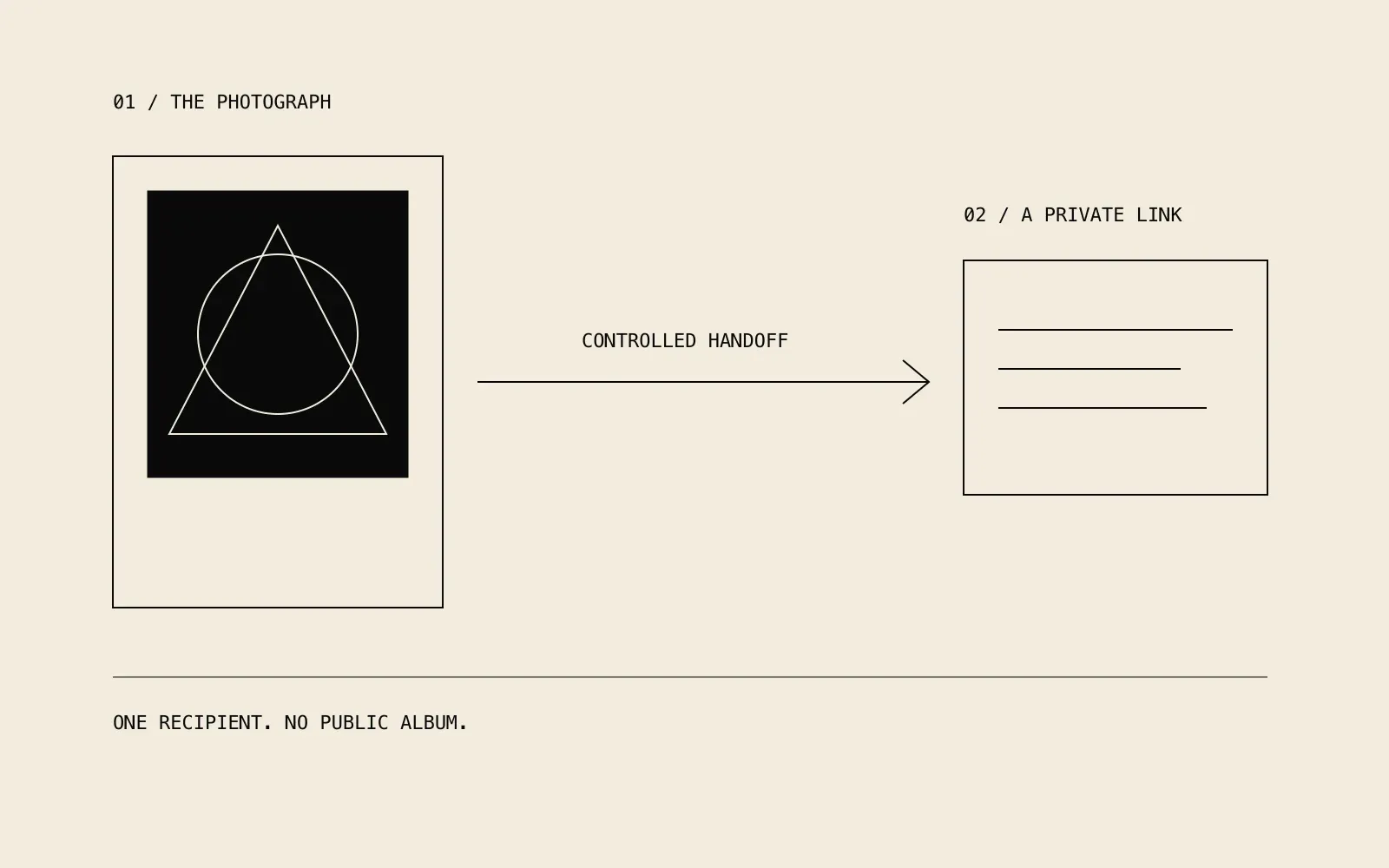
Someone has just had their photograph taken at a large local community event. The next step should be easy to explain.
Here is your link. Open it when you have a moment. There is your picture.
It should not require a new account, a password-reset email, or a search through a public album full of other people. Receiving one photograph is a small experience. It deserves software that understands its size.
That was the problem behind theProject.'s private event-photo delivery workflow. The visible page is deliberately quiet. The more interesting work happens before the photograph reaches it and after the visitor decides what to do next.
The workflow connects Studio, the private working side of theProject., with the public website. The two sides have different responsibilities, but the visitor should experience a single handoff.
Start with the person holding the link
It is tempting to begin an event-photo project with storage. Where do the files go? How much room will they take? How do we upload them quickly?
Those questions matter. They are not the first questions a visitor asks.
A visitor wants to know whether this is their photograph, whether it is ready, and how to save it. They may be standing outside on a phone. They may return to the link later. They may want to share it with someone they know. They may decide they would rather it not remain available.
Each of those situations changes the page. A useful design starts by making room for them before choosing how elaborate the interface should be.
That is why the workflow does not begin by asking the visitor to join a portal. There is no broader account relationship to maintain. The immediate job is receiving a photograph.
The picture and its delivery record are different things
Studio stores the media, but the media file alone is not the whole delivery system.
There is also a record describing what should happen to it. Has the photograph been prepared? Is it ready to show? Has someone asked for it to be removed? Is the delivery still available?
Think of the record as a claim ticket with a set of instructions attached. The file is the photograph. The record decides whether and how the website may present it.
Keeping those responsibilities separate makes several ordinary problems easier to handle. A link can exist while preparation is still underway. A removal request can change what the visitor sees without relying on a person remembering to edit a page. The public website can ask one narrow question about availability instead of being given access to a storage folder.
The machinery is more careful than the screen looks. That is intentional.
No public folder to wander through
A shared album is convenient for some events. It was not the right default for this experience.
A visitor receiving one image should not have to inspect everybody else's images to find it. Nor should the delivery page reveal where the original media lives or invite someone to change a filename and explore nearby files.
The link therefore uses an opaque address: an address that does not contain a person's name or a predictable photo number. The server checks that address against the delivery record before returning the limited information needed by the page.
Opaque does not mean impossible to share. Someone with a working link can pass it on. This is private-link delivery, not identity verification of every viewer. That is an important distinction when explaining what “private” means.
The purpose is to avoid a browsable public collection and keep the storage location out of the visitor's hands. It is not to pretend a shared address cannot be shared again.
Preparing the photograph is part of the product
The original and the image shown on a phone do not have the same job.
The viewing experience needs an image suited to the page. The download experience needs the appropriate saved file. Treating those as separate roles avoids making every visitor load a large original just to check that the photograph is theirs.
The record also needs to distinguish preparation from availability. If the image is still being handled, the page should say so plainly. It should not produce a broken-image symbol and ask the visitor to infer whether anything is happening.
A modest status message can carry a surprising amount of trust. It shows that the system knows which step it is in. That matters more than a decorative progress animation that cannot tell the person what to expect.
The public site gets only what it needs
Project Redefine, the public website, presents the photograph. Studio owns the media and the delivery decision.
The public page does not receive the private storage credentials. It does not receive an internal administration record full of fields the visitor never asked to see. It receives a small answer describing the available experience and the allowed actions.
When the visitor views or downloads the image, the server remains part of that boundary. It checks the request and provides the appropriate media path without exposing the underlying storage location.
This sounds like backend work because it is. It is also interface design. If the boundary is well defined, the page can remain small and predictable. It does not need to compensate for an accidental collection of backend details leaking into the browser.
Material study from the studio's visual system. This illustration accompanies the software story; it is not a photograph of an event participant.
An unavailable link should not become a detective game
There are several reasons a delivery might not be available. The address may be invalid. The record may have expired. A removal request may have taken effect. A backend service may be unable to respond.
The public experience should not expose a detailed diagnosis of the private record. It should give a consistent unavailable state and a practical next step.
That is kinder to visitors and better for privacy. A raw error message might reveal internal names or suggest that somebody's removed photograph still exists behind a different action. It also makes a temporary failure look like a technical problem the visitor is expected to solve.
The page's job is to explain what the person can do now. It is not a public window into the storage system's troubleshooting notes.
Removal is a normal part of the workflow
A photograph that was welcome on the day may not be welcome later. The delivery experience should leave room for that decision.
The removal-request path changes the record so that the private delivery becomes unavailable. That is more dependable than a contact link that merely promises someone will remember to search for the right image eventually.
It also gives the request a place in the system. Repeating the request should not create confusion or restore access. The action needs to be safe when a visitor taps twice or returns to the page unsure whether the first attempt worked.
There is a limit worth being honest about: making the hosted delivery unavailable does not recall copies someone already downloaded or shared. Software should explain the control it has, without borrowing authority over files it no longer holds.
Measure the service without collecting the person
It is useful to know whether a delivery system is being used. It is not necessary to turn every visitor into a marketing profile to answer that question.
The workflow records narrow operational activity, such as views, downloads, and removal requests. The private delivery route suppresses the normal public-site analytics experience. Personal media should not become an excuse to collect unrelated browsing information.
These measurements can help answer practical questions. Did the delivery get used? Are people requesting downloads? Is a removal path being exercised? They do not need a visitor's biography to be useful.
Choosing not to collect information is often a simpler privacy measure than collecting it and then building a complicated explanation for keeping it.
The failure cases are part of the experience
The most attractive screenshot usually shows the photograph ready and the download working.
The engineering has to account for the less photogenic moments too: an upload that is not ready, a missing derivative, an invalid address, a repeated request, a storage delay, or a service returning an error.
The system's tests exercise these states because they affect what a visitor can trust. A polished ready screen is only one part of a working handoff.
This is one of the quieter advantages of building around explicit records. Each state has a place to be represented. A failure does not have to be squeezed into the same response as a finished photograph.
Small local experiences deserve this care
There is no rule that careful software must be attached to a large organization or a complicated subscription product.
A photograph from one summer community event can deserve a considered delivery path. So can a class registration, a private client presentation, or a message sent by someone who is unsure whether their idea is worth asking about.
The right amount of software is the amount that makes the experience dependable without asking the person to adopt another system just to complete it.
Here, the desired result remains very small: open the link, recognize the photograph, save it if you want it, and know there is a way to ask for the hosted delivery to stop.
The work underneath exists so that the handoff can stay that simple.